Today's insight: Both the brain and body are constrained in their activity by the need to conserve energy and that constraint defines both.

We can't meaningfully talk about the body without talking about the brain. The latter is found spread throughout the former in a super-benign, cooperative parasitic-like enmeshing where parasite and host cannot now meaningfully function without the other.

Both are driven by survival, not of themselves, but of their union. In order for the brain to survive it has to make sure the body does. In order for the body to survive it has to have a high-functioning brain. The brain achieves its part of the bargain through its predictive ability.

It processes information, puts into effect cooperative actions with others, creates traditions, laws, social contracts, complex social structures and civilizations just so it can predict the next moment with some degree of certainty. The body then adapts so it can meet the next challenge and the ones after it.

Both brain and body exercise their roles within the overall umbrella of survivability which, in this case, is governed by bioavailable energy. Because there are no guarantees and the outside world is inherently unpredictable and challenging, everything the body and brain do is designed to save energy. The mindmap below illustrates this interdependence of the brain/body partnership.
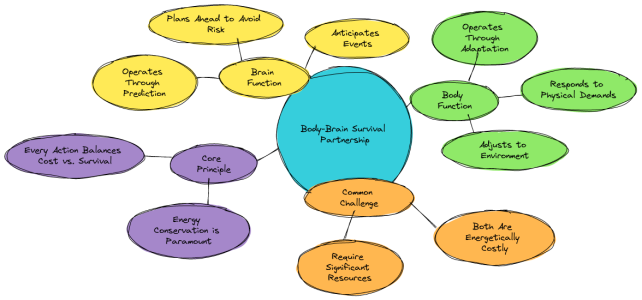
Brain-Body-Partnership.png
 
Today's insight: Your body learns through action. Your brain adapts to your intention.

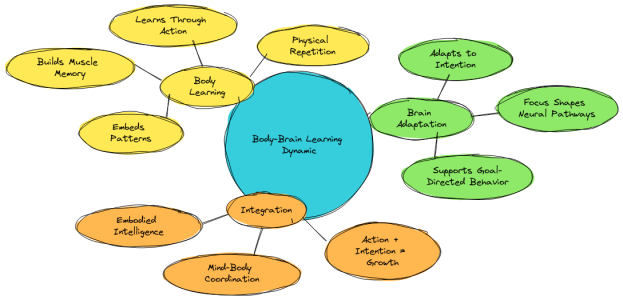
The body and brain have different learning pathways. The body learns through doing. If you want to be better at something you need to start doing it even if you suck at it. Over time, it gets better. The brain however learns through intention. There has to be a goal-oriented approach to something for the brain to allocate the resources required for new neural connections to be made (neuroplasticity) and new neurons to be created (neurogenesis). This is why RPG fitness is so effective, being in the present when training is so good and why RPG fitness programs, produce such great results.

The mindmap below expands, a little, on all this.


Body-learns-action-Brain-Intention.png
 
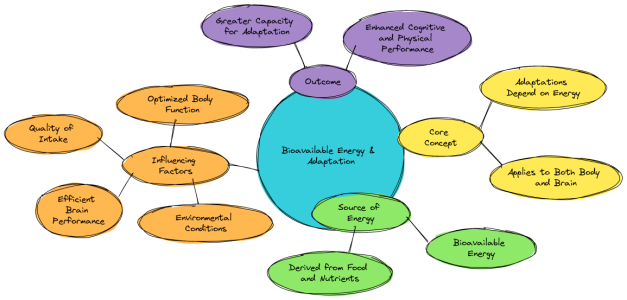
Today's insight: Every change we want to make to our body and brain requires energy. Things are complicated by the fact that often we have all the available energy we need for those changes but our body and brain cannot adequately access it.

The sum total of adaptations possible in any body and any brain depend on bioavailable energy. Bioavailable energy is dependent on the optimized working of the body and brain with their intake of food and nutrients in their environment so that the energy required can be delivered directly to those parts of the body that need it to power the processes that need to take place so the adaptations we seek, can occur.

Bioavailable-energy.png
 
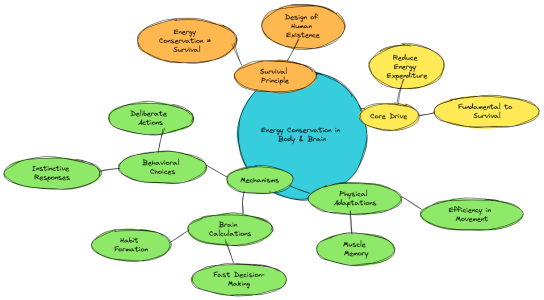
Today's insight: The body and brain do everything possible to conserve energy.

Everything the body and brain do, every change, every adaptation, every calculation, every deliberate choice, every instinctive response, are geared towards one basic thing: the reduction of energy expenditure. This highlights the core of our existence, specifically that we are designed to conserve energy in order to survive. It's worth keeping this in mind when we ask questions such as: Why does my diet stop working? Why do I have to vary my exercise routine? Why does training only one thing: i.e. strength, flexibility or aerobic capacity does not deliver positive health outcomes for long?

Energy-Conservation.png
 
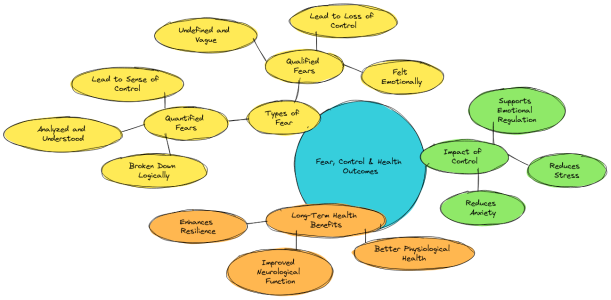
Today's insight: We control what we can quantify and what we can only qualify, controls us.

Fears and threats that we quantify (i.e. break down, analyze and understand) in our mind, we control. Threats and fears that we just qualify (i.e. sensing the emotional impact on us), control us. A sense of control leads to better long-term health outcomes because it helps us control stress and anxiety which would otherwise negatively impact our physiology and neurobiology.

Threats-Fear-Control-Health.png
 
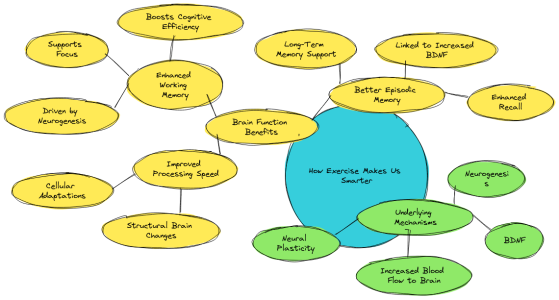
Today's insight: Exercise makes us smarter.

Exercise makes us smarter by improving the brain's processing speed, through cellular and structural adaptations. It improves working memory (our ability to retain instructions and thoughts in the short term), through neurogenesis. It helps improve episodic memory, (our ability to remember facts, feelings and events from the past) through increased Brain-Derived Neurotrophic Factor (BDNF) and improved neuroplasticity.

Exercise-Makes-Us-Smarter.png
 
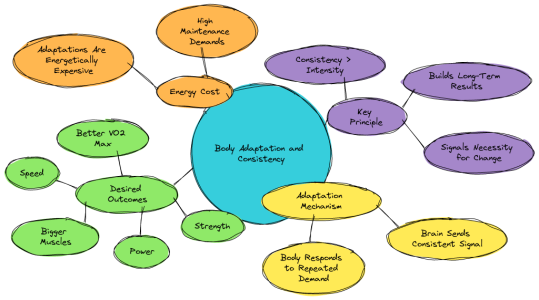
Today's insight: It is more important to do something every day than miss days and try to make up with intensity, instead.

The body adapts when it gets a consistent signal from the brain on the need for that adaptation to take place. Whatever we are looking for: speed, power, strength, bigger muscles, better VO2 Max, it is energetically expensive to build and maintain. Consistency trumps intensity because it convinces the body of the necessity to allocate the necessary resources, to adapt.

Consistency-vs-Intensity.png
 
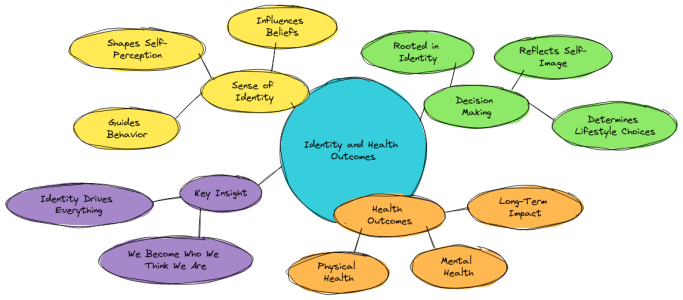
Today's insight: Who we think we are, guides who we become.

Our sense of identity and the long-term health outcomes we experience are pivotal to the decisions we make: we become who we think we are. Everything else follows that.


Identity-and-health.png
 
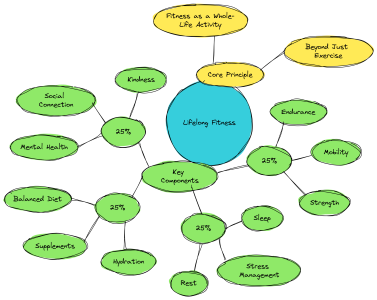
Today's insight: Lifelong fitness is more than just about exercise.

At best, exercise is only a quarter of the total of the activities we must undertake in order to enjoy good physical and mental health at every stage of our life. The other three pillars of fitness are good nutrition, adequate rest and meaningful social connections.

Four-Pillars-Of-Fitness.png
 
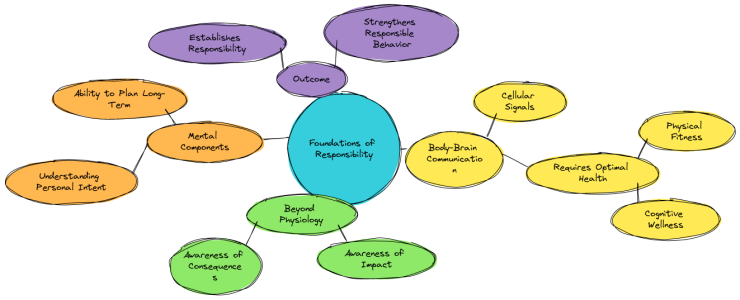
Today's insight: Responsibility, as a personal trait, starts in very small but important ways and is grounded in our physical health.

The signals sent by the body to the brain as it processes information from the world around us, at a cellular level, work best when both organs are at their optimum state of health. But there is more than that required to truly make us responsible.

An awareness of the impact and consequences of our actions. An understanding of our personal intent and our ability to plan long-term are key to establishing and then strengthening our sense of responsibility. Our physical health is a key component of our ability to be better people.


Responsibiliy-Health-Ethics.png
 
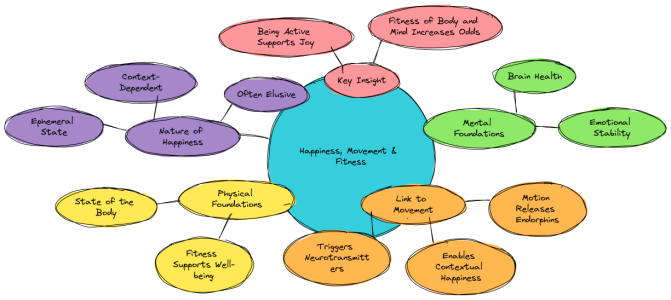
Today's insight: The ability to experience happiness is linked to the physical state of our body and mind.

We don't often think about it and we barely discuss it anywhere but happiness is linked to motion. Moving our body releases endorphins and triggers a cascade of other neurotransmitter-related events which make it possible to feel happy in certain contexts. Happiness is an ephemeral and often elusive state. By striving to be fit in body and mind we give ourselves the best chance possible to experience it.

Happiness.png
 
Today's insight: A reminder that just moving your body is never "just" moving your body.

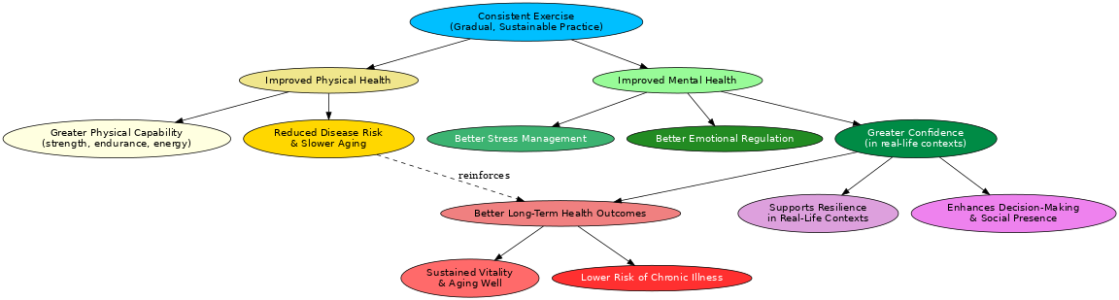
Gradually building your health through consistent exercise leads to better management of stress, better emotional regulation, a greater sense of physical and mental capability and therefore a greater sense of confidence in different real-life contexts which then leads to better long-term health outcomes.

exercise_health_confidence_clustered.png
 
Today's insight: Exercise affects us inside and out. We see the visible aspects of it because they're easy to observe and often overlook its hidden impact; the elements that actually matter in terms of sustainability and longevity.

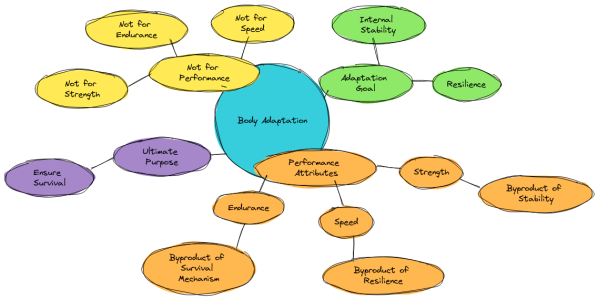
The body doesn't adapt for strength, speed or endurance. It adapts for internal stability and resilience whenever the above performance attributes are called for. Strength, speed and endurance are byproducts of the adaptations that take place to ensure our survival.

Cause-Of-Adaptation.png
 
Today's insight: We are intimately connected to what is going on around us all the time and it affects us both inside and out.

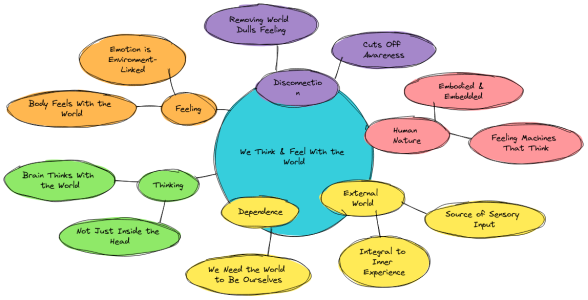
The moment we remove the external world from our senses we’ve also removed a large chunk of how we feel inside ourselves. We don’t think with our brain, our brain thinks with the world. We also don’t feel with our body, our body feels with the world. We need the world to exist as feeling machines that think.Think-and-Feel-with-the-world.png
 
Today's Insight: Almost everything we do is intended to help us establish a grater sense of control over our life.

This is straight out of Built To Last: "Life is chaotic for everyone. The degree may differ but we all experience forces we cannot control which then make us react to circumstances we have not created. This makes us feel stressed and helpless and when we feel stressed and helpless our body produces cortisol which is a stress hormone that impacts the liver, muscle, adipose tissue, and pancreas." [This is the direct but virtually invisible connection between what we feel and how we are]. Control-Cortisol-and-Health.png
 
Today's insight: There is no mind without the body.

Every movement reflects a neural architecture. This means that in everything you do through life you move not just with your body but also with your brain. The brain receives its primary input for thoughts through the body so every thought you have involves not just the brain but also the body.

Neural-Architecture-Mind-Body.png
 
Today's insight: Our natural reluctance to exercise never changes. To overcome it, as we age, we must evolve our thinking.

The stressors presented to us by exercise both internal (neurochemical and psychological) and external (load-induced fatigue) and our natural reluctance to it remain more or less the same throughout our life but our reasons that help us overcome our natural reluctance changes and evolve over time, as we do. We must constantly evolve to consistently overcome a stressor that is constant in our perception of it.

exercise-stressors-evolution.png