Flavorful8058

Posts: 8

Struggling with forward bends

If I try to keep my legs stiff, I can only get my hands down to my knees. My calves, shins and hamstrings feel weirdly itchy.

If I try to keep the knees soft, I can go a little deeper and the itchy sensation moves further upwards to the back of the knees, hamstrings and glutes.

If I bend at the knees I can reach my toes, and if I then try to gently straighten out, I feel a stretch in my hamstrings and nowhere else. No itchiness.

I've read the "How to Touch Your Toes" guide, and it talks about the sciatic nerve sometimes being a limiting factor. Is this it?

If so, is there a video of the nerve glide exercise that it explains? Because I'm not sure I'm doing it right 😅

 
@Flavorful8058 how long have you been training to try to touch your toes? Most adult humans cannot touch their toes with straight legs unless they train consistently to be able to do this. If you want to get there, do all of the exercises suggested in the guide, not just the nerve gliding one. You can mix it up: doing supine stretches one day, seated the next, standing the day after that, but definitely work on actual forward folding stretches, 2 minutes/day, minimum 5 days/week. I don't know of a video for the nerve gliding technique. The guide links to the study that used that protocol. You can click through to that and see if you can find more info on it that way.
 
@Flavorful8058 how long have you been training to try to touch your toes? Most adult humans cannot touch their toes with straight legs unless they train consistently to be able to do this. If you want to get there, do all of the exercises suggested in the guide, not just the nerve gliding one. You can mix it up: doing supine stretches one day, seated the next, standing the day after that, but definitely work on actual forward folding stretches, 2 minutes/day, minimum 5 days/week. I don't know of a video for the nerve gliding technique. The guide links to the study that used that protocol. You can click through to that and see if you can find more info on it that way.
I can't touch my toes and that's what I'm training for. I've been doing forward folds (and variations like on the floor and seated) for a couple weeks now. Admittedly I haven't been super consistent with it, so that coooould be part of the problem...

...but it's also that what I'm feeling while doing them doesn't feel like other stretches. It's not a pulling feeling, it's itchy (I genuinely can't find a better way to describe it, I'm sorry 😅), and it appears in spots that I don't think should be under tension (the shins for instance). This happens for all variations I've tried. I'm mostly looking for confirmation that this is the nerve tension the guide talks about, because it describes the feeling as tingly and electric and that doesn't quiiite match what I'm feeling.

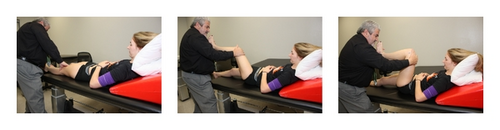
I did look at the study that's linked, but the sliding technique it describes is different from that in the article because it's performed on someone who is lying down, by a physical therapist: josm127471-fig-0004-m.png
I did look around a bit to see if I could find pictures that matched what's in the article, and I found a couple that were somewhat similar but nothing that was a clear match.
 
Hmm... I've not heard the sensation of a hamstring stretch manifesting exactly as you experience it before. But sciatic nerve irritation can manifest in a fairly wide range of places, and pain and itch sensations travel along the same pathways to your brain. So I think it is possible your brain could be interpreting sciatic nerve upset as itchiness in this case. Certainly, considering the fact that you have not done much training to be able to touch your toes thus far, it is likely your nerves are part of the limitation at this point. Also, the fact that you cannot currently reach past your knees with straight legs suggests you also need to work on mobility in your lower back and hip flexion in order to ever reach the floor. In my experience (as a yoga teacher), students who cannot reach past their knees always have limiting factors beyond just their hamstrings.

The exercise depicted in those images from the study looks like it could be quite useful for you. If you don't have someone to help you do it passively, you could try doing it yourself with a strap. Wrap the strap beneath the ball of one foot and use your hands to pull your foot towards your face, flexing your hip, knee, and ankle as you do so. Then release. You'd need to actively extend your leg and plantar flex your ankle in this case. But I think you'd still get most of the benefits of the protocol used in the study.

Admittedly I haven't been super consistent with it, so that coooould be part of the problem...
That's definitely part of the problem. Consistency is key.