Damer

Warrior Monk male from Terra
Pronouns: He/Him
Posts: 1,189

From The Recesses Of My Mind

I train every day and have more or less done this for the last 47 years. Sharing what I do will not be of much help. But the thoughts I have about exercise and the insights I gleam about the way we work (our operating system, so to speak) may actually be useful. I've thought for a long time about the merits of putting it all in a log like this. I'd love to hear what you think as you come across it.

Today's insight: Exercise is doing something inefficiently until it becomes efficient.

The body is an optimization machine. The adaptations that lead to the visible aspects of fitness (big muscles, better VO2 Max, leaner physique, etc) are the direct result of changes that must be made in order to reduce the body's energy expenditure when performing something. The moment efficiency kicks in, the exercise stops working as intended. We need to switch it up.

 
I think it's very interesting to pay attention to what comes before exercising, the reasoning, the desires but also to what happens after, how you are and where you want to go.
There are plenty of sites and trainers that tell you what to do but no one can explain why to do it :)
 
Hi Sensei,
that motivation thing is very interesting.
I catch myself while trying to make 5 minutes plank on elbows, asking myself why am I doing this. After third minute, back and shoulders are in pain, whole body tembling, breathing is hard, and you have to continue, no break. I know that is good exercise, but in that moment it's just torturing. At least I'll get few thumbs up from community. :)
 
Today's insight: Each day is different. We are different in it.

We do not operate in a vacuum. We are an open system. Our internal states respond to stimuli received from the external world: daylight hours, noise, air pollutants, air-born pathogens, contaminants, other people, external situations. All the things we cannot control. Most times we are unaware of all this because we just focus on our own struggle to get through the day. Then, when we cannot do something as well as we usually can (exercise, work, life) we blame ourselves. Being aware of what goes on inside us is not easy. It requires energy and a little time and thinking. We are not always inclined to do it. But if we get into the habit of questioning ourselves: Why do I feel this way? Why am I responding to this situation in this way? We develop a better awareness of what goes on inside us. Even when we don't have the exact answer for the internal condition we experience we at least become aware of the change - we know something is different. That helps us understand better why we have 'good days' and 'bad days' when it comes to performance and mental clarity.
 
Today's insight: Crazy day! I could have done with one more brain which means to say it was super stressful.

The double-sigh: a really deep breath that fills the lungs and the diaphragm to the max and then, just when they're full, one half-breath. Really helps relieve stress by activating the parasympathetic nervous system and returning the body to a stable base level.
 
The double-sigh: a really deep breath that fills the lungs and the diaphragm to the max and then, just when they're full, one half-breath. Really helps relieve stress by activating the parasympathetic nervous system and returning the body to a stable base level.
I need to train on this one, i tried but i am not doing it correctly i think. Thanks !
 
Today's insight: No one knows what you feel.

We could argue that no one knows what you're thinking until, of course, you make it obvious. But that's not always true. Thinking follows a logical trajectory that's firmly rooted in reality and anchored by the choices available to you. Another person may know what you're thinking without you telling them because they are familiar with a situation and its context. It's like we can know what will happen on-screen when watching a movie if we have seen the movie before or, if not exactly the same movie at least a dozen or more very much like it. There are only so many possible options for action that arise out of a given context. But feelings are not like that. They rise out of stimuli provided by the external world but they are expressed through changes in our internal condition. Those changes are not the direct result of the stimuli we experience however. They're the result of our interpretation of the stimuli based on our own memories, experiences and knowledge. Two people watching the same sunset will have different feelings but similar actions before, during and after their viewing of the setting sun. The point is that unless you articulate how you feel, no one knows. Sometimes, not even yourself.
 
Today's insight: We all get tired.

Being alive is a struggle. The body's involved in energy expenditure to maintain our internal balance, combat disease, repair tissue, build muscles and create new neural connections. It all can feel exhausting at times without ever taking into account the things we have to do to get through the day and the additional things that come at as from the world beyond us. Fatigue is a state but also a feeling. It's important to differentiate between the two. I may not want to take the garbage out at night because I'm tired but when I pause and quantify the effort: 50 yards to get to the bin, not being able to do it feels ridiculous and I also don't then feel "too tired" to do that. It's important to ask ourselves these questions. Part of the fatigue we feel is subjective (our brain makes it seem more than it is) and some is objective. Knowing the difference is important.
 
Today's insight: We live on sunlight

No, really. What keeps us alive each day is the energy that's sent out by the sun in different radiation bandwidths. Of course we can't consume that. It's absorbed by plants and turned into fiber and carbohydrates. Plants are consumed by animals who turn it, in turn, into complex proteins and fat. We then consume these secondary sources, our body breaks down the chemical bonds that have been created to capture the sun's energy and it is released. Feels kinda neat to know all that because it makes us realize just how connected we are, at a cellular level, with the universe.
 
Today's insight: Choice is an issue only when we don't understand our priorities

Modern life gives us an abundance of choice. Choice defeats decision-making by overloading us. It overloads us when we don't have our priorities right. We don't have our priorities right because we don't know who we are. When we don't know who we are we don't know what we want. It becomes difficult to choose anything then.
 
Today's insight: There is a battle raging inside each of us. The 'me' part that feels that nothing is going our way, against the 'we' part where just being alive and experiencing the present is a gift.

The child inside us never truly goes away. It's always there, in the background, yelling, screaming and throwing things. It wants to bend reality to its will by sheer force of a temper tantrum and when it fails it wants to scream, and yell and break things. Adulting is the filter we apply. The layer that tells us it's not just 'I'. There are other people around us. Other perspectives and a larger reality, and they all matter. Adulting provides restraint and (maybe) wisdom and it's damn hard to do.
 
Today's insight: Every feeling, every thought, every emotion and every action has a point of origin that caused it.

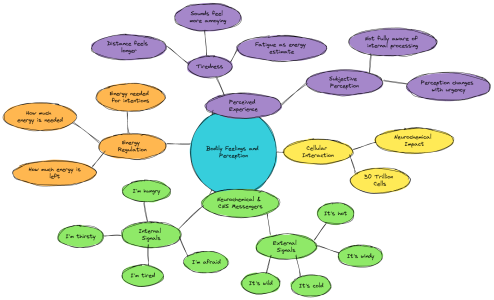
Everything we feel inside of us is the result of the interaction of the matter that constitutes us (our over 30 trillion cells) with the neurochemicals that impact them. Neurochemicals and the electrical impulses of the central nervous system (CNS) are messengers. The messages they carry our from the external world (i.e. it's cold, it's hot, it's windy, it's wild) and our internal systems (i.e. I'm hungry, I'm thirsty, I'm tired, I'm afraid) which then impact how our cells function by determining how much energy we have left, how much energy we need and how much energy we might need if we do some of the things we are thinking of doing. We're not really aware of all this. What we feel, instead, is that the distance from where we are to somewhere we need to go now feels longer if we are tired. Or that the noise of a tap dripping in the background has now become really annoying because we are tired. Tiredness, fatigue, is a complex feeling: it is the estimate of "how much gas we have got left in the tank" and how much further we intend to go at that moment. Part of it is very real. But part of it is perception and it can change if the urgency of what we are dealing with changes.

The mindmap below illustrates what I've written, exactly.
kuIW8rqfQm.png
 
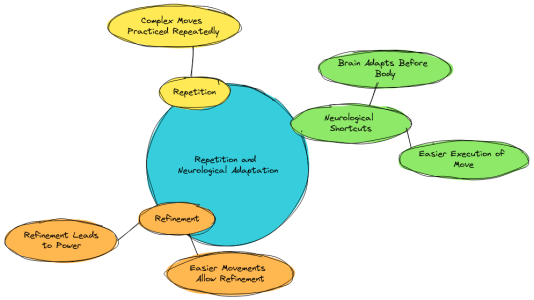
Today's insight: Repetition builds neurological shortcuts.

A complex move we do over and over again leads to neurological adaptations that make it easier long before it leads to physical ones. It's because we find it easier that we can then refine it so it becomes more powerful.

Here's a handy mindmap that beautifully illustrates the concept:

Repetition.png
 
Today's Insight: All exercise affects the brain but different types of exercise have different effects.

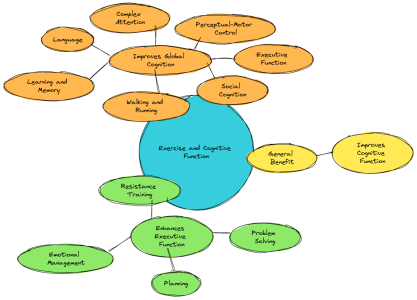
Resistance training helps improve executive function: the mental skills we use to solve problems, make plans and manage emotions. Walking and running however help improve global cognition: complex attention, executive function, learning and memory, language, perceptual-motor control, and social cognition. So it's never a case of choosing one over the other as 'better'. There is no such thing. We need a wide range of exercise to help us develop the holistic mental skills we need not just to survive but to thrive.

Resistance-training-vs-running.png
 
Today's insight: (More of a public acknowledgement really)- I am dysfunctional.

I was talking to a podcast host about my past and my education background and he said: "you're really smart then". I am not. Not really. Those of you who read "Built To Last" know that I use exercise as a coping mechanism. I am fit because of the general dysfunction of my past and it is something I need to help keep my thinking clear and my emotions regulated. I use my brain the same way. I look for patterns, seek reasons and analyze what I see for general rules which then give me a clearer sense of comprehension and order to what may appear to be chaotic processes. This allows me to impose a sense of control over a world that cannot really be controlled. That sense is important to me and I freely share what insights I derive in the hope that others may also derive a sense of control and the comfort that goes with it when they gaze upon the world. I make my particular dysfunction work for me both physically and mentally, that's all.
 
Today's insight: Exercise always affects us but not all exercise affects us the same way.

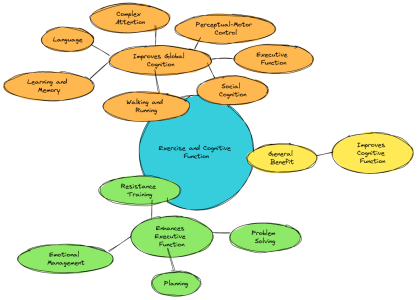
Lifting weights, martial arts, dancing, activate the brain. So does walking, jogging and running. The physiological changes we experience because of exercise (lower cortisol levels, improved cardiovascular fitness, better mood and higher oxygen levels in the bloodstream) are the same. But there are differences in how the brain is activated. Executive function is needed to achieve focus for goal-oriented tasks, motivation and emotional regulation. Lifting weights, martial arts and dancing will activate all that. But walking, jogging and running activate global cognition: attention, executive function, perceptual-motor function, learning and memory, language, and social cognition. This is why walking, for instance, helps "clear our head" and make better decisions. It's never a case of either/or. We need to exercise in everything in order to be better humans.

Resistance-training-vs-running.png
 
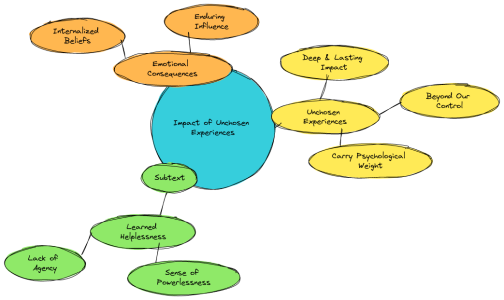
Today's insight: The things that we control least affect us most at the point of impact with us.

There is a bridge that is created from the things we experience physically to the connections, beliefs and values we create mentally and it's built by the Impact of Unchosen Experiences. The things we do not get to choose always have the deepest, most lasting impact upon is because they come with the subtext of our learned sense of helplessness.

impact-of-unchosen-experiences.png
 
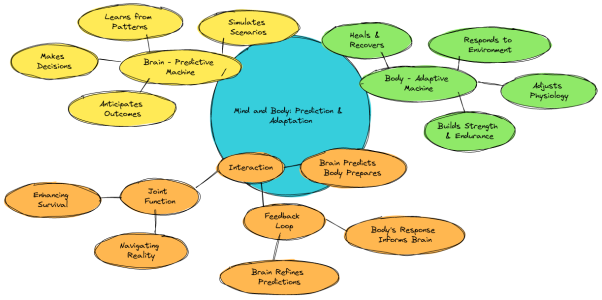
Today's insight: The brain is a predictor. The body is an adaptor.

The brain and the body are incredibly complex. At the same time they're fundamentally simple. The brain strives to predict the next moment. The body seeks to adapt to its environment. The visual below explains it all.

Body-Adapter-Brain-Predictor.png
 
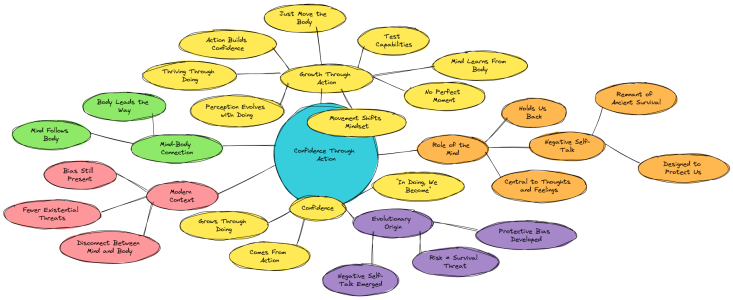
Today's insight: Confidence comes from action. It's that simple. In doing, we become.

The mind follows where the body leads. While the mind is central to so many of the things we do and everything we feel and think, it's also designed to hold us back. The negative self talk we have that constantly undermines us is there to protect us. But that's a remnant from a past where every chance we took and every risk we faced had existential consequences. We don't live in that past any more. Today we grow and we thrive by doing. It's the same with exercise. There is no perfect moment or perfect opportunity. We just need to move our body and test its capabilities and everything else will follow from there.
 
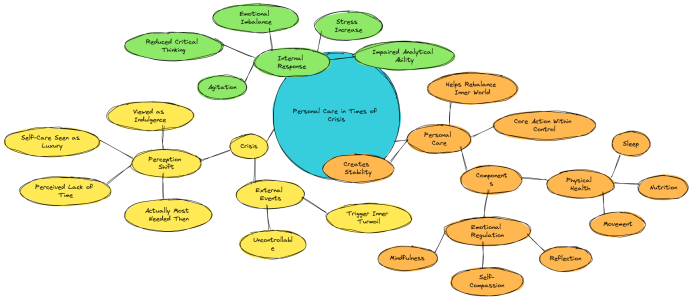
Insight of the day: During a perceived crisis, self-care becomes optional.


A crisis is an irrefutable perception of the pressure exerted on us by uncontrollable external events. It triggers a cascade of internal processes in us that have finite external expressions. Self-care is the ultimate crisis-defusing tool-kit. Ironically, it is also the first casualty of a perceived crisis. To break the cycle we owe it to ourselves to focus on our own self-care routine. This is the one thing we can control and because we control it, it provides us with a strong sense of capability that was not there before. That delivers to us the sense of stability we need in order to make better decisions.

self-care-expanded-more.png
 
Today's insight: Move your body. Preserve your mind.

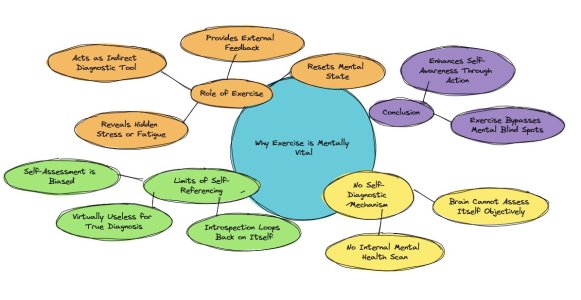
Exercise is the only low or zero-cost intervention we have on making sure our mental health is preserved and our cognitive abilities are honed as we age. The simple act of physical movement triggers a cascade of internal events inside us that activate a feedback loop between the body and the mind which then goes a long way towards helping us maintain sharp cognitive abilities and good mental equilibrium by moderating our emotional responses to external stimuli.

Exercise-as-mental-diagnostic.jpg
 
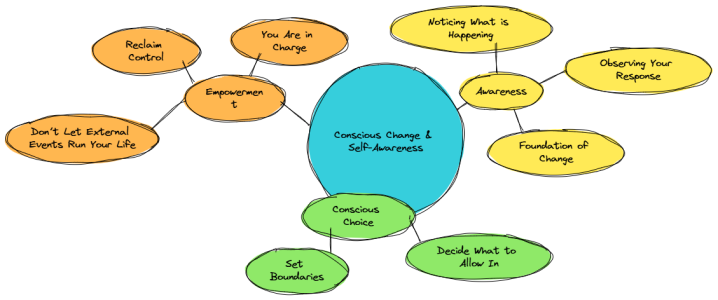
Today's insight: Conscious control of your life starts with small changes.

Noticing what is happening and how you are responding is the foundation of change. Make the conscious choice of what you allow into your life and don’t let a mass of circumstances you can't control run your life, you are in charge. But for that to happen you need to start small: understand your responses. Prioritize what is important to you. Be comfortable with making choices that reflect your direction and not the expectations of others.

Control-Your-Life.png
 
Today's insight: Move your body, change your mind.

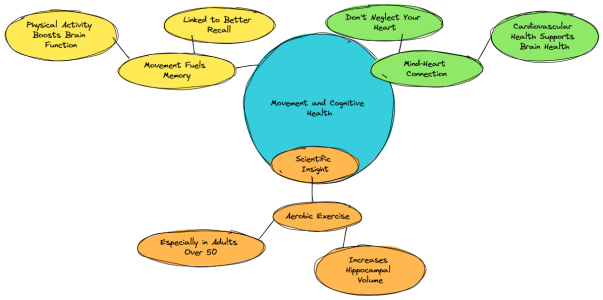
Who we are and the sense of what we are capable of is constructed out of the memories we have, the experiences we've been through and remember, and the knowledge we have accumulated and can recall. Memory plays a pivotal part in all of this and in the human brain the hippocampus is a site for decision-making and committing information to memory for future safety uses. Thus it has a mechanism to convert short-term memory into long-term memory, consolidating verbal and symbolic thinking into information that can be accessed when needed for decision-making. A larger, healthier hippocampus improves all of these capabilities and aerobic exercise helps the hippocampus get larger and remain healthier as we age.

Illustrative mindmap as usual:
Aerobic-exercise-brain-health.png
 
No, it wasn't my purpose, rather thanking you and let you know i appreciate even if it is not something i am comfortable to have a discussion with, so i don't have any comments. But it is good anyway to thank you for your time. So thank you, don't feel like having to change anything.
 
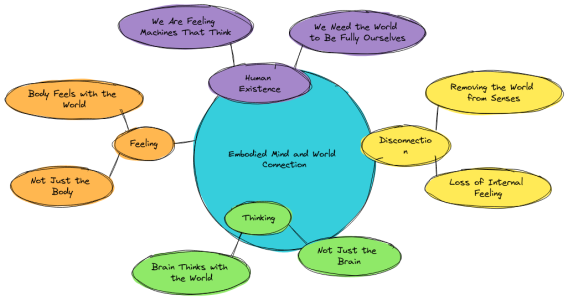
Today's insight: What the body and mind experience comes from outside. The inside we perceive is a response to the processing of the outside signals we receive.

The moment we remove the external world from our senses we’ve also removed a large chunk of how we feel inside ourselves. We don’t think with our brain, our brain thinks with the world. We also don’t feel with our body, our body feels with the world. We need the world to exist as feeling machines that think.

The mindmap that illustrates this better:

We-think-With-The-World.png
 
Today's insight: The only expert on you is you.

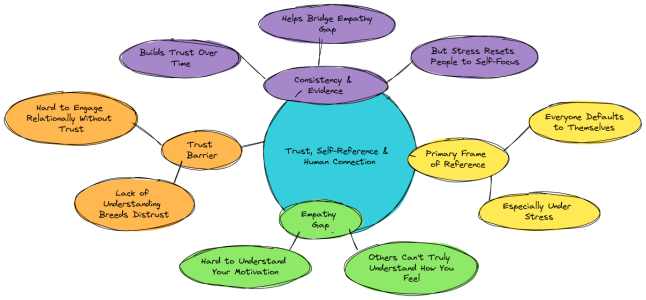
Everyone's primary frame of reference is themselves. No one truly understands how you feel which means they find it very difficult to understand what motivates you and this makes it hard for them to trust you. If they can't trust you they find it hard to engage in any relational exchange with you. You can argue that when we have a consistent evidential basis then all this becomes easier but even then, when they experience stress everyone defaults to their primary frame of reference because it's easier. (Obligatory mindmap below). Happy Pride month.

Trust-and-stress.png
 
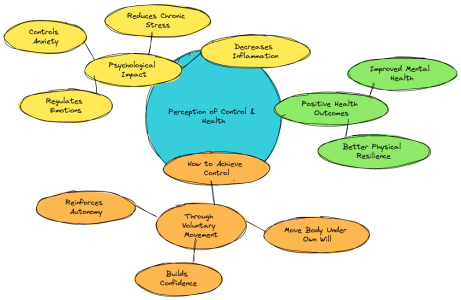
Today's insight: Everything is about control.

Our perception of control allows us to regulate our emotions, reduce chronic stress and inflammation and control anxiety, all of which have a host of positive health outcomes. The easiest way by far to achieve that perception of control lies in our ability to move our body under our own will.

Control and health.png
 
@graoumia thank you very much for adding this here and I am sorry I am just now getting to it. It's been a crazy week! Moving our body grants us a lot of capabilities but it doesn't magically solve all our problems. The external world continues to challenge us. The problems we have remain the problems we have. What changes is how we deal with those challenges and problems. We always need to use our brain to solve things and while we do that we will always feel some level of stress and anxiety. The difference lies in how much stress and anxiety we feel and what they do to us. When stress and anxiety overwhelm us the body reaches critical levels of stress and the higher centers of the brain we use for analytical thought shut down because they drain too much energy. We are then left with the reactive part of us. We can react to what stresses us but we can never hope to find a way out that will truly solve it. Exercise, however light, is a stressor to the body. When we stop the body readjusts to balance our biomarkers so we are calmer and less reactive than before. This also creates for us the capacity to deal with extra stress because, internally, from a neurochemical point of view we have dropped below our baseline. Dealing with the challenge or problem at hand will be stressful but because we are already starting from a lower baseline than before, it becomes easier to deal with the extra stress and anxiety without feeling overwhelmed and losing control.

I hope this helps explain it a little better. But ask me to clarify anything that needs further explanation.
 
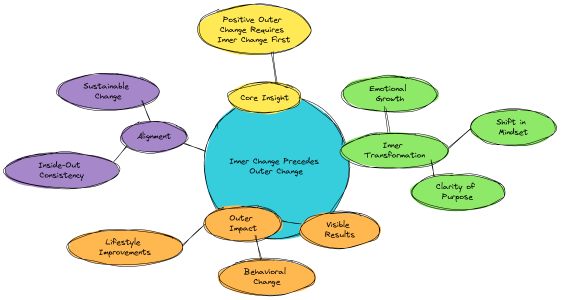
Today's insight: Every positive change to the outside of us is preceded by positive change to the inside of us, first.

Our body responds to the external stressors we apply through exercise by better understanding and re-prioritizing what is important to us at an emotional and psychological level. This is why it is so important, in fitness and health, to establish clearly who we are and what we want out of life.

r3knbMEgHA.png
 
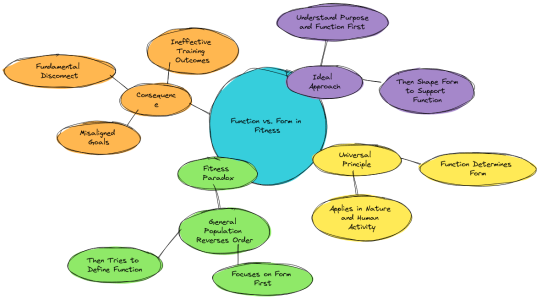
Today's insight: In fitness we often reverse the natural order of things and it leads to many of the difficulties we experience.

In nature function always determines form. The Cheetah is the fastest animal on land and it looks a specific way because of its requirements to be fast to catch its food and survive. The same goes for Elephants or Whales. Or any animal on the planet. Athletes look a particular way because of the requirements of their sport. Yet when it comes to our own fitness we don't think about "function" first. We think about "form". We want to be lean or strong or fast or muscled without considering how we'd use and therefore maintain that look. So it leads us down a path where we chase something antithetical to our needs and foreign to our everyday activity. This makes it hard to achieve and hard to maintain. If we started with function first however, and clearly defined it we'd find it becomes way easier to achieve the form we need.

Function and Form in Fitness.png
 
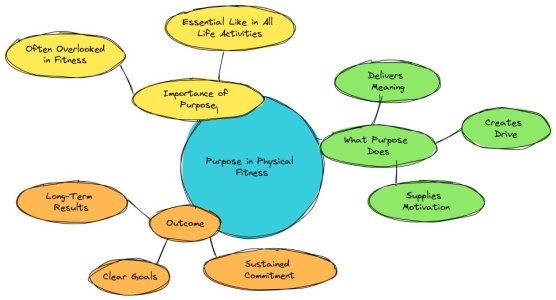
Today's insight: What we often fail to grasp is that “purpose” is as necessary in physical fitness as it is in every other activity of life. It creates drive, delivers meaning and supplies motivation.

Purpose allows us to prioritize our actions and put order in our thoughts. Prioritization creates focus and determines what is important to us. All of this is a 'manual' on what to choose to do, when, where and why.


Purpose-in-fitness.jpg
 
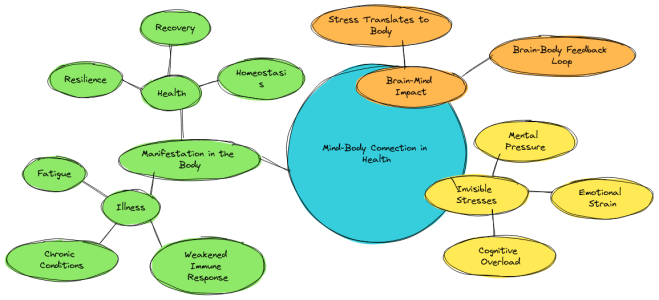
Today's insight: In illness and in health we see being manifested in our body the invisible stresses that impact our brain and mind.

Some illnesses are due to pathogens and are unavoidable. Some are due to genetics and they're hard to dodge. A lot however, are the result of a combination of factors. Socioeconomic conditions, environment, lifestyle, diet and a lack of support network. I have not even began to scratch the surface here. What is true however is that whatever illness we're facing is only amplified by poor emotional regulation, chronic stress and high anxiety levels. All of these surreptitiously and persistently undermine our physical, cognitive and mental health and make us more susceptible to everything else around us. Conversely, better management of all of these leads to overall better, long-term health outcomes. We're more resistant to disease, mentally more resilient and we live longer and age slower.

Illness-and-Health-Connection.png
 
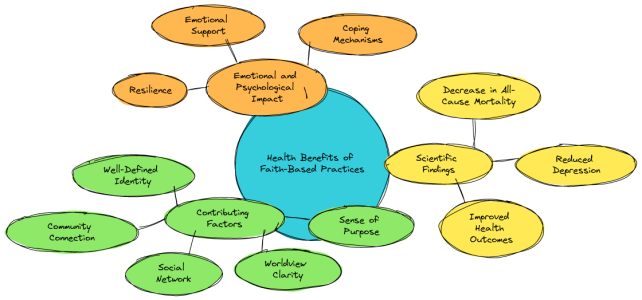
Today's insight: A strong sense of faith helps us stay healthier.

Faith is linked across dozens of studies with a reduction to all-cause mortality, a reduction in depression, less stress and better mental health. This is not just about having faith or just going to some kind of place of worship. It's what stems from such actions. A sense of faith is linked with a strong sense of hope, better defined values and the ability to make better sense of the senselessness of the world. Attending a place of worship links us to other people, helps create a strong sense of belonging and being part of a community. These, in turn, reduce chronic stress and inflammation and help us stay healthier, longer. As always it is meaningful human activities and human practices that help us stay anchored that actually help. Most frequently these are expressed through community activities and traditional practices and being spiritual, as opposed to being religious, is linked to all of these things.

Faith-and-health.png
 
Today's insight: The story we tell our self about who we are affects both our body and mind.

When we construct and reflect on a personal narrative, or self-narrative it can positively impact mental and physical health. Being personally aware of the impact of personal experiences, especially in an emotional way, can lead to improved well-being and resilience. This process helps us organize our thoughts and emotions, manage stress, and develop a stronger sense of self.

Power Of Self Image.png
 
Today's insight: Most times in fitness what holds you back is you.

What hold you back is your negative self-talk, your fears, your insecurities, your worries that if you try you will fail and evidence of failure is worse than the hope that if you really tried some day you might succeed. You are worried about how you look and what others think about you when in truth no one cares. Everyone else has their own problems and only see you in relation to themselves.

Self-limiting beliefs.png
 
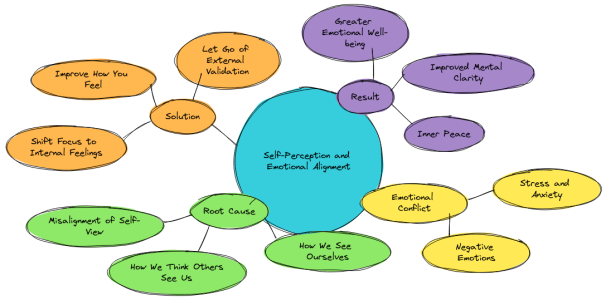
Today's insight: Most problems we feel and the stress we experience is produced internally by ourselves. Our thoughts, ideas, experiences and expectations shape the inner world we experience.

A lot of stress anxiety and negative emotions emerge from the misalignment between how we see our self and how we think others see us. Focus instead on how you feel and strive to improve the feelings you experience and everything will then be better.

Self-Perception-Emotional-Alignment.png
 
I read this morning that there is a new study published in PNAS recently that suggests diet is the significantly larger culprit in obesity. I have not read the study itself, just a journalist-level summary of the study through interviews and, presumably, reading the study. But it looks like something you'd be interested in reading. Unfortunately, I do not have a title for the study, but its senior author is Dr. Herman Pontzer.
 
I read this morning that there is a new study published in PNAS recently that suggests diet is the significantly larger culprit in obesity. I have not read the study itself, just a journalist-level summary of the study through interviews and, presumably, reading the study. But it looks like something you'd be interested in reading. Unfortunately, I do not have a title for the study, but its senior author is Dr. Herman Pontzer.
Thank you so much for tagging me here. I have already seen it and I am doing some more follow-up reading about it.
 
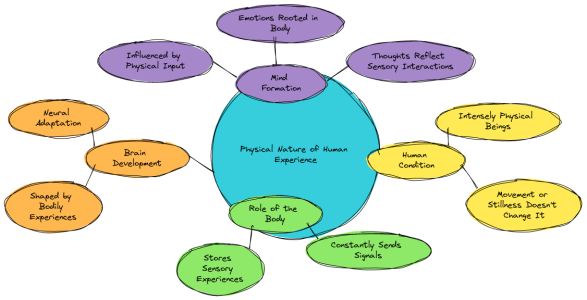
Today's insight: Whether we exercise or not move a lot or not the fact is that we are intensely physical beings. Our brain and our mind are shaped by everything our body experiences.

The emotions we experience and the thoughts we have come, in the first instance, from stimuli that are provided by our surroundings. It is our senses that provide the raw material we use to process which then gives rise to feelings that lead to thoughts, decisions and, eventually, actions. All of this will happen regardless of whether we move our body or not. But, if we decide to move our body, under our own volition, in a decision we made, we've taken the first step towards establishing a necessary sense of control in our life.

Physical-Nature-of-Human-Experience.png